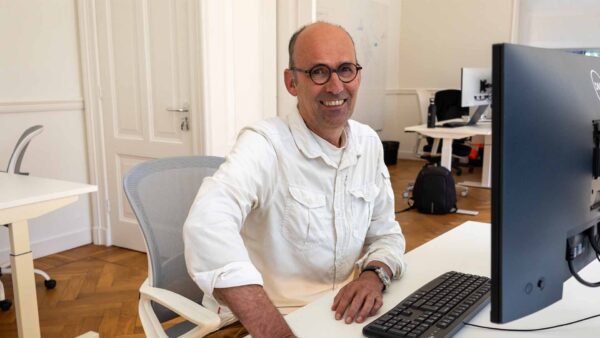

Ten years ago, Arjen joined IMAGEM more or less by chance. He has since become a key member of the development team—critical, sharp, and always with a sense of humor. In this interview, he looks back on his first day, shares his perspective on the field, and talks about a memorable bike ride to a hackathon in Poland.
"I've worked on many projects over the past ten years. But Oneport the online store for the U.S. Department of Agriculture (USDA) really stand out."
— Arjen Haayman, developer
Do you remember what your first day at work was like?
Sure. My first day of work was actually supposed to be at another company in Apeldoorn, but my laptop wasn’t ready there yet. At IMAGEM , I happened IMAGEM up a conversation with Wouter and was spontaneously offered a better position. It felt right right away: I was IMAGEM familiar with IMAGEM and had worked on a predecessor to Oneport. Plus, a laptop was ready and waiting for me right away. The three of us—David, Wouter, and I—were in the office in Apeldoorn, so that was a quick introduction. The rest of the team was still working in Capelle aan den IJssel at the time.
In your opinion, what has changed the most over the past ten years?
Our company has completely transformed. In the beginning, we worked extensively with Smart M.Apps and mainly sold Hexagon software. Now, our focus is on our own solutions and services. We have many more developers and build much more in-house.
How would you describe your work in one sentence?
Building apps with maps—those are exactly the two things I enjoy. I’ve been working with maps for almost my entire career. It all started by chance, but it never ceases to be interesting.
What has been your most memorable moment over the past ten years?
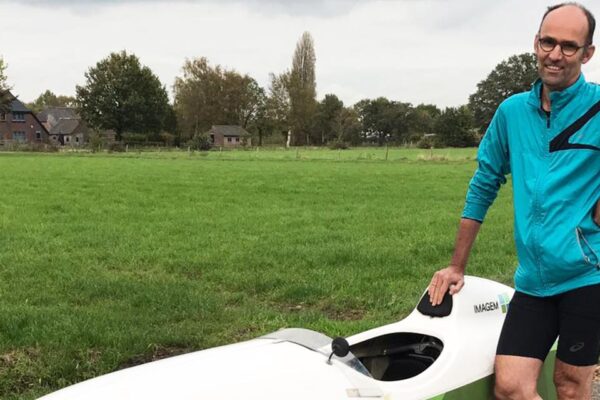
That I cycled to Poland for a Hexagon hackathon. I’ve been there three times to learn about smart applications. I cycled there once: 1,050 kilometers round trip, in November. I had a cover over my recumbent bike and was completely enclosed, which was nice, especially on that one day with drizzle. No snow, thankfully, but it was cold. A great experience.

Which project are you most proud of?
It's hard to choose—I've worked on so many projects. In the early years, I mainly worked on prototypes. But Oneport and the web shop for the U.S. Department of Agriculture (USDA) really stand out. Within six months, we had a system in place that allowed them to make five petabytes of aerial photos available to the public. People could view and order them online. It worked great.
What's the strangest or funniest bug you've ever come across?
I tend to forget about actual bugs quickly—you fix them and that’s that. But at the Land Registry, we once included an “Easter egg” (a hidden feature that a developer embeds in an application) in a map file: a black border where I’d written “Greetings, Arjen.” You normally couldn’t see it, until someone opened the file in a viewer with a font bug. Then that message suddenly appeared huge on the screen. I had to explain myself for that. And we once had a photo album with hidden photo effects: as soon as you hovered your mouse over the photo, a smile with a star or a wink appeared. Little jokes among developers.
What have you learned over the past 10 years that you’ll always carry with you?
Flexibility. Technology is constantly changing. I’ve recently started using AI while coding. I was skeptical at first, but it works surprisingly well. It helps me work faster and better. However, it’s not a black box—AI explains clearly what it’s doing. But you still have to think for yourself. AI is a tool, not a replacement. Even at home, where I’m building a site for the Fietsersbond, I’m now using it as an experiment.
Which programming language would you take with you to a desert island?
JavaScript. Flexible, forgiving, and versatile. Java is too rigid, and while C gives you a lot of control, it’s also very prone to errors. JavaScript has a massive ecosystem. Everything you need has already been solved; you just have to know where to look. AI works well with it, too. It’s the language of the internet. As long as the internet exists, JavaScript will remain relevant.
What prank or office tradition has stuck with you the most?
We have an unwritten rule among the developers: if you leave your screen open and unattended, you have to treat everyone to cake. It’s never actually happened, but the threat is always hanging in the air.
What’s your secret tip or piece of advice for new colleagues?
Stay curious and flexible. Keep up with the latest developments and keep learning. I follow a lot of content on YouTube, use Mastodon, and attend the annual VUE Conference in Amsterdam—the world’s largest conference on Vue.js, featuring speakers from all over the world. That’s also where I first saw a demo on AI that really impressed me. The creators of Nuxt also share new updates every week. That helps me stay sharp.
Do you have a guilty pleasure at the office?
I absolutely love cookies and cocktail nuts. And if possible, I like to sit in the sun. Unfortunately, the parking lot won out over my beloved picnic table.
Would you like to swap workplaces with a colleague for a day?
No way, not even for a day—I'm just fine 😉
If your code had a soundtrack, what song would it be?
“The Fez”by Steely Dan. Just because it swings.
Where do you see yourself in the coming years—here with us or elsewhere?
I think looking ahead is a waste of energy. You can come up with all sorts of ideas, but things always turn out differently anyway. That goes for everything. I try to set things up so that I can handle whatever happens. Will my work still exist in ten years? I have no idea. A lot of it is still done by hand right now, but that’s changing fast. Still, I hope I’ll still be here in five years. I’m really enjoying myself.
What would you do if you could work for a whole day without any error messages?
Then I’d be out of a job. My work revolves around things that don’t work properly. An intern once remarked, “You guys only focus on what doesn’t work.” And that’s true. As a developer, you’re constantly looking at bugs, edge cases, and things that aren’t quite right. It’s a bit of an oddity, but that focus is what drives progress.
What are you working on right now?
To Planspace Simulator. And privately, a site for the Fietsersbond, featuring an interactive map where people can use photos to show what’s happening in Deventer.