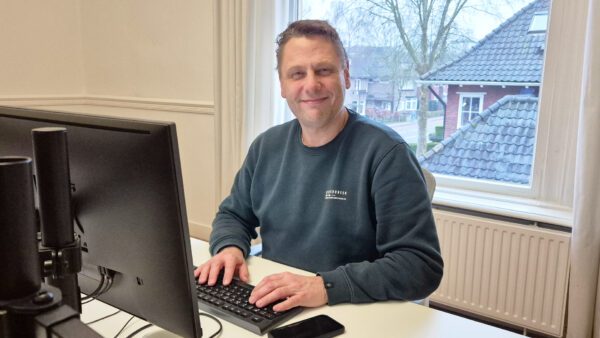
Harald Gortz may not consider it particularly remarkable himself, but his work speaks for itself. He has been working at IMAGEM for five years now, where his fascination with remote sensing, maps, and sustainable solutions all come together. As a business consultant, he knows how to bridge the gap between technology and real-world application, while his hobbies—photography and drones—effortlessly complement his work. “If I blog about a green roof, I’ll install one myself,” Harald says matter-of-factly. During our interview, he takes us into his world of innovation, collaboration, and creativity. But as a true storyteller, Harald regularly veers off into other topics along the way. The result of an enthusiastic workaholic who loves to share his knowledge.
"Geoinformation and remote sensing you remote sensing look beyond the surface. They provide insights that can truly make a difference, for example in the area of sustainability." Harald Gortz, business consultant
Please describe your job.
I am a business consultant specializing in the public order and safety sector. In my role, I serve as the link between technology and the business side. I help clients use our software effectively. Sometimes that means coordinating with the tech team to have something developed or with support to resolve an issue. And sometimes we work with the client to develop a plan. You get to see every aspect of the process: from theory to hands-on implementation.
What achievements are you most proud of?
I’ve done a lot of great things, and the best part is that we do it all together. But I’m most proud of my contribution to the NOS documentary *The War That Never Ends*. It always starts with a story, but by using remote sensing, you can back up that story with facts. For example, we combined data from 80 years ago with modern imagery to turn a historical folk tale into something tangible. It’s amazing to see how data, teamwork, and research come together and how you can prove that something actually happened.
What is your background?
I originally studied environmental science, specializing in nature conservation. It was a program that brought together all the subjects I enjoyed: from land use planning and urban planning to geoinformation, which was still a subfield at the time. I found it so interesting that I went on to specialize further in geography-related fields and eventually started working in this area.
Geoinformation and remote sensing you remote sensing look beyond the surface. They provide insights that enable you to make a real difference, for example in the area of sustainability. For instance, remote sensing only lets you identify which roofs are suitable for solar energy, but also calculate the potential yield or recommend alternative solutions, such as solar water heaters or reheat panels. You can even use data to determine where in the city it is hottest in summer and winter, allowing you to strategically install green roofs or implement sustainable energy solutions.
What do you like about working at IMAGEM?
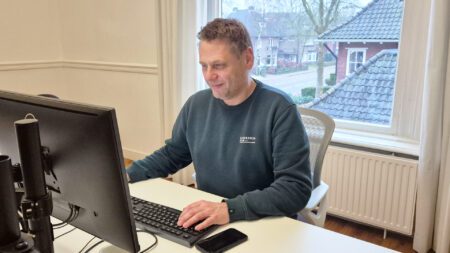
The team spirit. IMAGEM a small company; we know each other, seek each other out, and inspire one another. Over lunch, drinks, or a game of pool, we have the most diverse conversations. The level of expertise in our team is truly high. Everyone, from developers to process specialists, brings unique insights to the table. Plus, we’re great at sharing that knowledge with others, for example during knowledge-sharing sessions. And everything else is always well-organized, from inspiring events to the practical logistics.
For example, on behalf of IMAGEM , I IMAGEM lead knowledge sessions at the HAS Green Academy. There, I discuss topics such as point clouds— whatthey are and how they can be used—and geoinformation. Did you know that geoinformation is used in a surprising number of places? Take UPS delivery trucks, for example. They’ve developed their own navigation system that routes them to make only right turns whenever possible. Why? A right turn improves traffic flow and reduces dangerous right-of-way situations. Plus, it’s safer for drivers who don’t have a door.
What's your favorite project right now?
Ministry of Defense. It’s great to work together on projects that really make a difference.
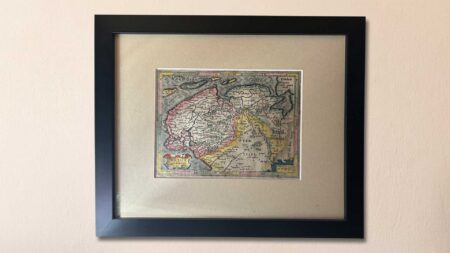
Harald's favorite card.
Maps are wonderful, whether they date back to ancient times or are from your vacation. My favorites are the maps created by cartographers in the 15th and 16th centuries. They are graphically impressive and incredibly accurate, given the techniques available at the time.
Actually, every map is a bit of a lie. Scales aren’t always accurate, and there’s artistic license to emphasize certain things. For example, in the past, they used to warn of monsters on the map. And on elevation maps, for instance, shades of green and blue are used. But in a desert, those colors aren’t useful because people associate blue and green with nature and water, and you don’t have that in the desert. That’s what makes maps so special: they serve a purpose and tell a story.
What are your fondest memories with the team?
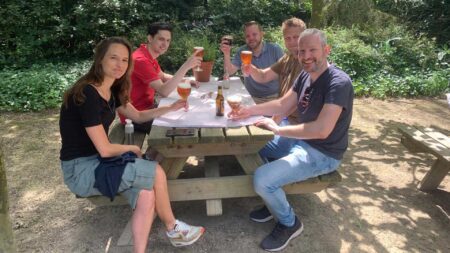
During a team outing, we played "Hunted." While we were being chased, we passed by a charming little terrace. We decided to stay there, took a nice photo, and relaxed with a beer. When other teams asked us where we were, we said, "We're not giving away our location." That's a really fond memory for me.
What attracted you to this job?
It's actually quite nice. I started out with vector GIS and later worked with open-source geocomponents. Remote sensing was new to me, but IMAGEM Hexagon a lot of expertise in that area. Working with raster images and point clouds was a logical next step. What I appreciate is the balance: challenging projects, great colleagues, and enough space for my personal life. In my previous job, I felt more connected to the companies I was seconded to than to my own employer. IMAGEM exactly the small-scale approach and collaboration I was looking for.
Who on the team would you like to switch jobs with?
With Peter. He’s the linchpin of the organization, seamlessly blending the hard realities of finance with the softer aspects of the business. From making sure there’s enough bread for lunch to making complex strategic decisions, he handles it all. I greatly admire his dedication and sense of balance.
What was the first thing you learned at the company?
Working with Erdas software and blogging. My first blog post was about Beirut and the images taken after the explosion, and how you can use remote sensing Erdas to make the invisible visible.
In three words, how would you describe your job?
Challenging. Innovative. Fun.
Who was your first desk mate? And who is it now?
I joined the Sales team right away, where I worked alongside Robbert, Niels, and Tjip. Later, Stefan joined us as well. From the very beginning, it felt like a close-knit group of colleagues.
If you could change one thing about the company, what would it be?
Nothing at all. This is fine.
Tell us something about yourself that not many people know.
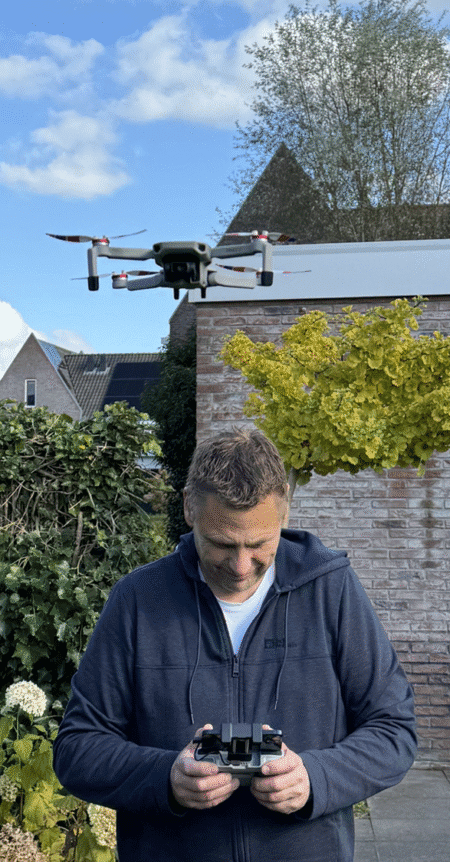
In addition to my love for drones and photography, I enjoy spending a few nights out in nature with a backpack full of food and drinks and a tent. I bring my camera and drone along and just wander. I enjoy the variety of landscapes—geological formations, for example, or the transition from the coast to the forests, or stumbling upon a waterfall. I look for landmarks on maps; there’s always something to see in the landscape. I capture my own aerial shots with my drone. Discovering new places—whether on foot or by car—is something I truly love.
Is there anything else you'd like to say?
IMAGEM just a great place to work. The projects are interesting, the colleagues are fantastic, and time just flies by. Five years already—wow. Keeping up with the latest technology is the best part. Things are moving at lightning speed, and the possibilities just keep expanding. That’s what makes it so challenging and fun.