
When you consider how complex the world around us is, it’s truly remarkable how well people are able to understand problems and turn them into solutions. But does that also apply to our systems? Systems primarily rely on predefined rules. Yet they struggle immensely with anything that doesn’t fit neatly into a box. If only our systems could think and act like humans, it would make our lives so much easier. We believe it’s possible. Is the sky the limit, or will it remain just a dream?
We humans are very aware of our surroundings. In order to understand what is happening around us, we instinctively break the world down into smaller pieces, which we then try to make sense of. We go to school to learn and gather validated information that we store as knowledge to draw upon later. We learn to think scientifically in processes, which allow us to connect the pieces. We also learn to reason. This helps us explain events, draw conclusions, or make predictions based on existing knowledge and structures.
People and nature are unpredictable
Because the volume of data is constantly growing, we use computers to help us. By automating data processing, we can gain a much deeper understanding of our environment. It would therefore be useful to fit the world into a clearly defined model, but in reality, that is an impossible task. To model something, you need to know in advance what could happen and take all possible situations into account when building your model. By “possible situations,” we mean “known situations” or situations we can predict based on reasoning. And that’s where the problem lies, because nature and humans are capricious and unpredictable.
The computer systems we’ve developed so far to assist us are designed to automate and optimize the handling of data within these boxes. The approach, architecture, and implementation of today’s fourth-generation technology are focused on optimizing business processes. This works well for simple or straightforward processes, but usually not for digital services. Whenever it comes to advising people, we see things go wrong. After all, people primarily want attention and care, not just efficient automated processes.
Things also go wrong when unexpected events occur. Unfortunately, there are plenty of examples of this. The benefits scandal is one such example where a process began treating people like numbers. An unempathetic computer-driven process led to an automated decision that backfired completely. This has had very serious consequences for those involved, mainly because their voices were not heard beforehand.

Focus on what matters
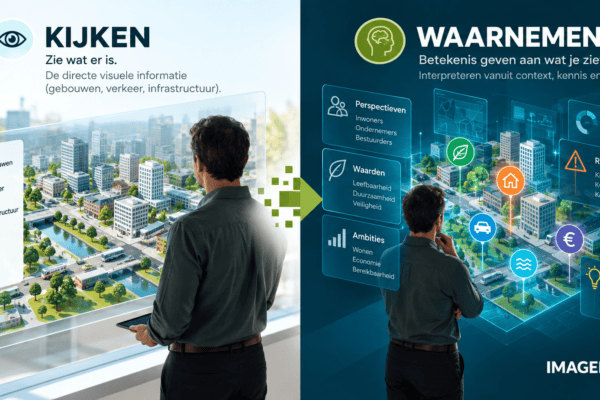
Have you recently had a lunch meeting or a team meeting at a restaurant? During such a lunch meeting at a restaurant, it’s not exactly quiet. Many tables are occupied, and everyone is engaged in their own conversations and issues. A cacophony of sounds, voices, cutlery, and waiters passing by. There are simply too many of these signals to process. But we humans are highly trained to filter. From everything we perceive, we can apply focus and pick out only what is relevant in the context of what we want to achieve. So we focus on our tablemates, because that is relevant within the context of our goal. And to avoid starving, we briefly focus on the waiter to place our order. What can we learn from this to improve digital services?
Active listening is key here. This requires having a clear understanding of the goals you want to achieve. If you take in all the information and data without filtering it, you’ll quickly end up with “information overload.” That’s why filtering helps. And we do this based on our goals. We filter at every level: in a restaurant for noise, in a conversation by topic, and within a sentence for words that help us understand the message the other person is trying to convey. Being curious about the content of the conversation helps us build the right context from it and form an opinion.
The model of our time
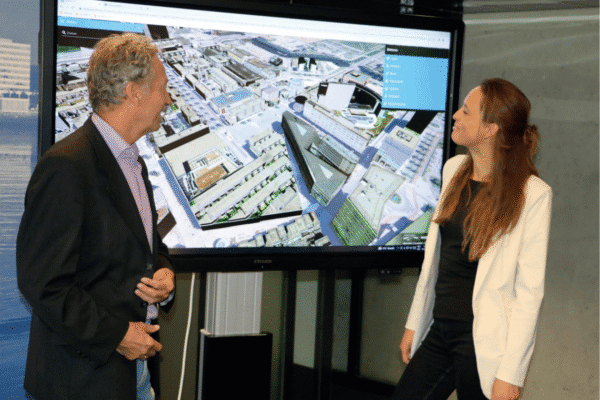
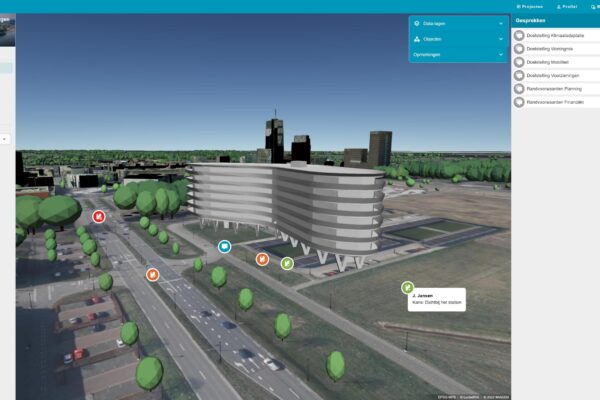
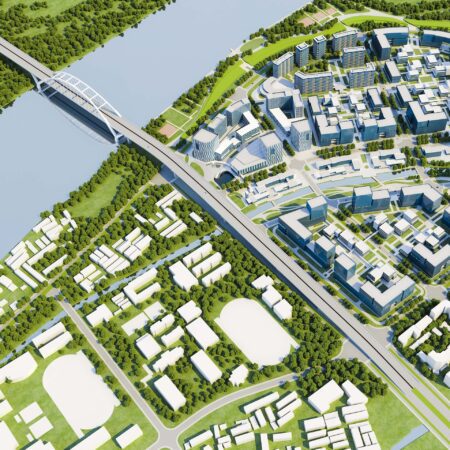
In the past, we used to create scale models of future scenarios. The advantage of a scale model was that several people could gather around it, and everyone could offer their perspective on it. Digital twins are today’s scale models. Not only do they accurately bring together all the knowledge about an area—such as underground pipes and buildings—but they are also highly precise and help visualize effects like shadowing. The advantage of a digital twin that everyone can view it through the lens of their own expertise, yet from a single shared information source.
When we have an opinion about something, it requires the discipline to respond rather than react. A response is a form of reaction, but it incorporates the outcome of that reaction into the response. In plain language: think before you speak or act. Don’t react based on data alone, but be mindful of the context. Because when we are aware of our surroundings, ourselves, and our shared goals, we can reason from our context to arrive at an appropriate and proportionate response. This may all sound very logical, but the principle of listening rather than acting is the difference between adaptive action and reactive action.
Next-generation IT
Speaking of adaptability, we’ve come to expect nothing less in our personal lives. People want customized solutions and want to be involved. Just look at the massive growth in apps where people can access personalized services anytime, anywhere, and instantly, such as Uber. Or apps where people can engage and have a say in matters relevant to them, like Instagram and LinkedIn. These services are based on mobile internet computing, and we refer to this as fifth-generation technology.
The current third- and fourth-generation IT systems used by the government, business service providers, and most companies do not yet operate in this way. They are not designed for participation and personalized service delivery based on mobile internet computing, because they were not conceived with that in mind and therefore were not built that way. Changing these systems will soon become necessary, and the transformation represents a paradigm shift. It requires a completely different approach and mindset, as well as a great deal of courage. Because transformation is difficult and painful. But the current situation is also becoming increasingly painful, and delaying it only prolongs the pain.
What is the conclusion of our story? That to provide effective digital services, we need a next-generation of systems that are adaptive through active listening and more empathetic and understanding through context awareness. We believe that a transformation toward fifth-generation technology is much better suited to the way the world works. This transformation is primarily not about technology, but about people. However, adaptive technology is a necessary support and the only way to deliver personalized services in a rapidly changing, complex world.
We are developing technology for organizations that listen and show empathy, and a collaborative environment where people and machines reinforce each other by focusing on what they each do best. This helps organizations harness their full workforce potential. We are building our dream of helping the government and the business community transform toward fifth-generation technology. This creates adaptively conscious organizations that can make the best decisions at any given moment based on context-rich facts. We would love to build that dream together with you. As far as we’re concerned, the sky’s the limit!