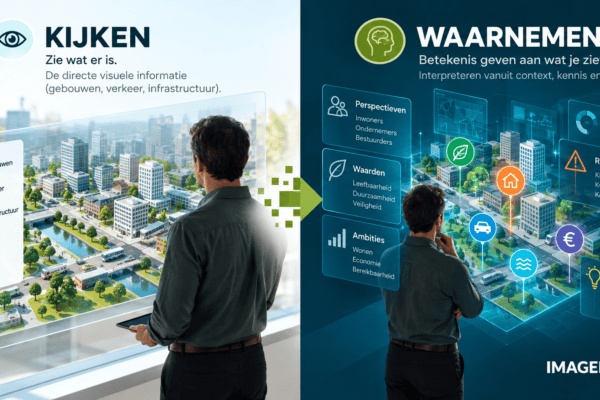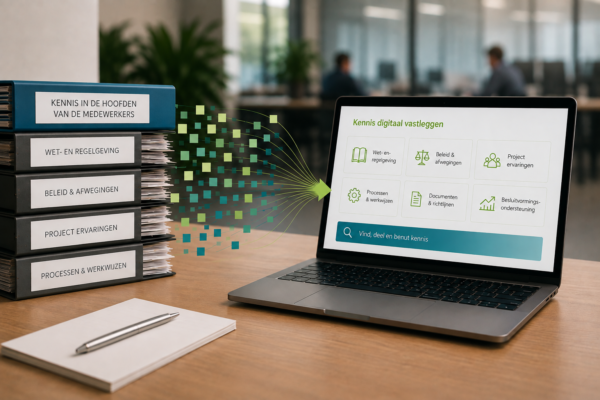

The Netherlands has created a complex landscape in which spatial development, the energy transition, climate adaptation, mobility, and societal interests constantly intersect. How can you still make sound, transparent, and well-founded decisions within that complexity? Digitalization helps bring together information, policies, regulations, interests, and scenarios; provides insight into consequences; and allows for the comparison of alternatives. This creates the space to reach better decisions more quickly and collaboratively. But digital innovation requires more than just technology. It also requires an approach suited to complex, cross-domain issues. This affects not only how you work and collaborate, but also how you procure and contract for solutions. After all, if the issue changes, can the way you organize it remain the same?
The Illusion of Certainty
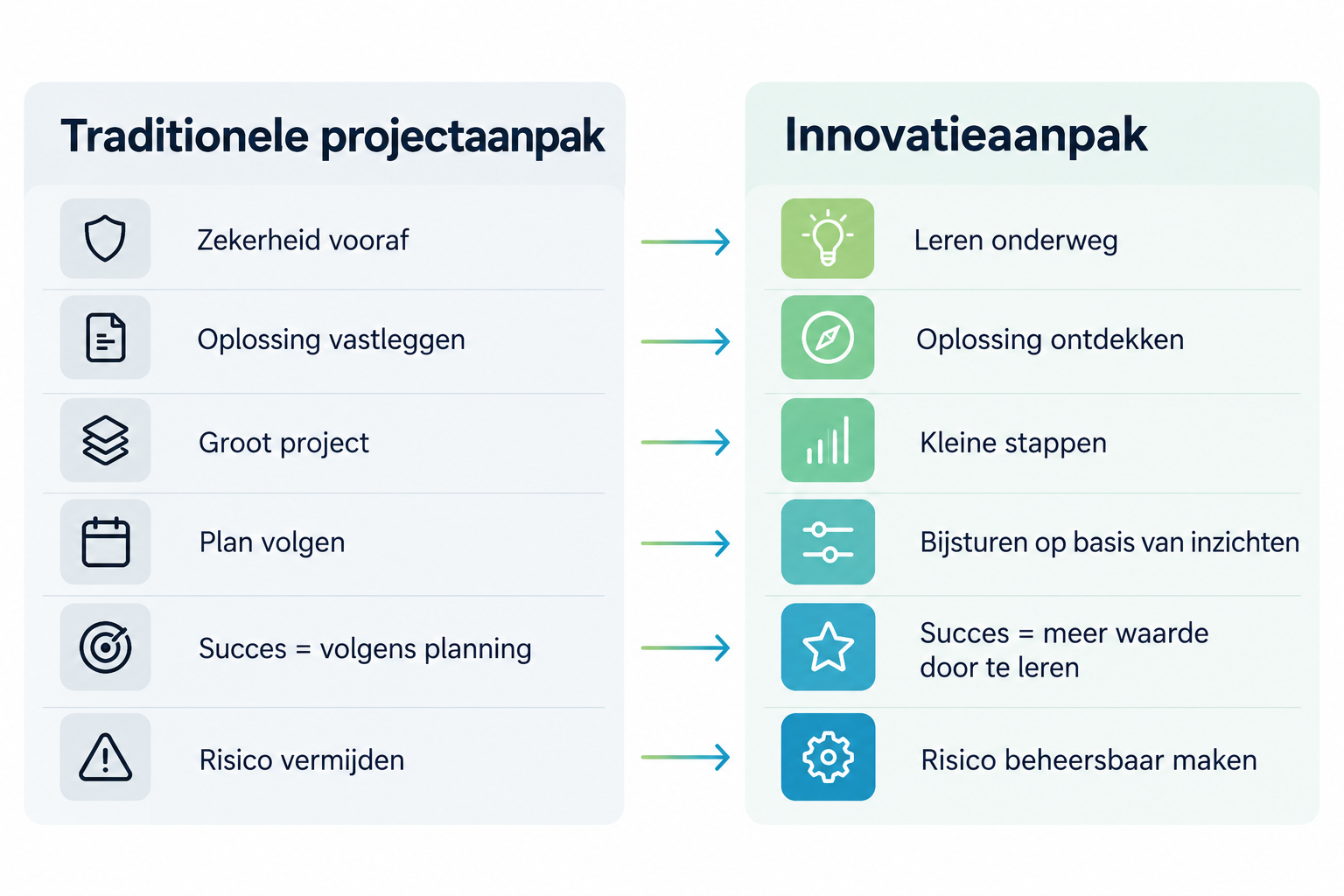
When starting a new project, you want clarity up front—about the outcome, the schedule, the budget, and who is responsible for what. That need for clarity is understandable, especially when you’re working with public funds and need to be able to properly justify your decisions. But what if the issue can’t be clearly defined in advance and the best solution isn’t yet clear? Or if different domains, interests, and responsibilities are so intertwined that a single, well-defined solution isn’t enough? That’s exactly where digital innovation calls for a different approach—not only in how you develop a solution, but also in how you collaborate and, ultimately, in how you procure and award contracts.
Complex issues call for a different way of working
A complex task cannot be fully predicted. New insights emerge during the process. Users respond differently than expected. Legislation changes. Technological capabilities evolve faster than anticipated. That doesn’t mean plans are unnecessary. It does mean, however, that a plan is less and less of an endpoint and more and more of a starting point. The question thus shifts from “How do we implement this preconceived solution?” to “How do we discover, step by step, what the best solution is?”
This way of looking at things aligns with the Cynefin Framework developed by organizational expert Dave Snowden. He distinguishes between simple, complicated, and complex issues. For simple and complicated issues, analysis, planning, and predictability work very well. For complex issues, things work differently. The right solution only becomes apparent during the process. Snowden therefore advocates an approach in which you experiment, observe what works, and take the next step based on those observations. Not because planning is unimportant, but because learning is essential when the outcome is not yet certain. That requires a different way of working.
Digital transformation also requires a holistic approach
Digital innovation does not stand alone. The challenges we are tackling are not only becoming more complex; they are also becoming increasingly intertwined. Spatial development intersects with mobility, energy, climate, data, policy, and societal interests. Yet we still often organize these issues across separate departments, disciplines, and areas of responsibility. This is where digital innovation intersects with digital transformation. You can digitally consolidate information and deploy new technology, but if people and departments continue to work from their own narrow perspective on the issue, ultimately little will change. Digital transformation therefore requires an integrated approach, in which knowledge, data, and different perspectives come together—not with everyone working from their own partial solution, but collectively, focused on the challenge at hand.
Don't start with the solution; start with the question
In many innovation projects, the conversation starts with a potential solution. “We want a Digital Twin.” “We need an AI solution.” “We’re looking for a new platform.” It sounds logical, but you’re actually skipping an important step. The first question isn’t what technology you need. The first question is why. What problem do you want to solve? What challenges are you facing today? For whom do you want to make improvements? And what does success actually look like? Especially with complex issues, the first solution is by no means always the best one. Sometimes the real challenge lies somewhere other than where you initially thought. By first exploring the question behind the question, you create space to truly understand the problem. Only then can you work together to discover which solution adds the most value.
Don't plan everything in advance; learn step by step
In digital innovation, value is often created in small steps. An initial version is tested with users. Feedback leads to new insights. Some ideas prove valuable right away. Others are set aside. Not because the project fails, but because real-world experience reveals something different than initially anticipated. That process may feel less predictable. In reality, however, you’re actually reducing the risk. By starting small, you avoid investing years into a solution that ultimately doesn’t align well with reality. You test assumptions early on, discover more quickly what works, and build only on the components that actually add value. Incremental innovation, therefore, isn’t about making small improvements simply because “small” is better. It’s about learning. Every step yields new knowledge that strengthens the next step.
Daring to learn also means daring to fail
That may well call for the biggest change of all—not in technology or processes, but in the way we think. Many organizations still judge an experiment based on a single question: “Was it a success?” But innovation doesn’t work that way. During the most recent MGM Event, Professor and Chief Failure Officer Paul Iske spoke about “failure intelligence”: the ability of organizations to learn from things that don’t go as expected.
In a complex environment, it’s impossible to know everything in advance. That’s why experimentation and failure are part of innovation. The question isn’t whether something will fail, but whether you’ll learn from it
— Paul Iske, professor and Chief Failure Officer at the Institute for Brilliant Failures
That doesn’t mean failure is a goal in itself. It means organizing your experiments so they remain manageable. An incremental approach makes that possible. By starting small, evaluating regularly, and applying insights immediately, you prevent a wrong choice from turning into a costly project. If something doesn’t work, you don’t lose years or millions. You gain knowledge that makes the next step better. Perhaps that’s why the biggest change isn’t technical, but cultural: not striving for a flawless project, but for an organization that keeps getting smarter because it dares to learn.
Five Principles for Innovation in a Complex Environment
A different way of working does not require a completely new project methodology. It requires a different way of looking at innovation. Five principles form the basis for this.
- Start small: Don’t begin with a large project where everything is set in stone from the start, but rather with a first step that you can test quickly. This way, you’ll discover early on what works and avoid investing months or even years in a solution that doesn’t adequately address real-world needs.
- Involve users from the start: The best ideas don’t come from sitting at a desk. By involving users early on, you gain insight into what they really need. Their feedback helps you make choices that truly add value.
- Make learning part of the process: In innovation, learning isn’t a stepping stone—it’s the goal. Every iteration yields new insights—not only about the technology, but also about the user, the organization, and the problem itself.
- Adjust your course based on new insights: A plan is not a final destination. New knowledge sometimes calls for different choices. By regularly evaluating and making adjustments, the solution remains aligned with reality rather than with past assumptions.
- Dare to accept that not every experiment is successful: Not every idea turns out to be the right direction. That’s not a waste—it’s part of innovation. It’s precisely by experimenting on a small scale that risks remain manageable and each experiment yields valuable insights for the next step.
These five principles reinforce one another. If you remove just one—for example, the freedom to experiment or the willingness to adjust course—an innovation project will quickly revert to a traditional project approach. The focus then shifts from learning to control, even though it is precisely the learning process that determines whether an innovation will ultimately be successful.
From Project to Learning Process
Digital innovation requires a process in which not everything is predetermined. You start with the problem, take the first step, and assess what that yields in practice. You incorporate new insights into the next step. In this way, the solution emerges during the process, rather than simply implementing what was conceived at the outset. This also changes the nature of collaboration. Clients, users, subject matter experts, and developers don’t just work sequentially; rather, they collaborate with one another throughout the process. Users are involved early on, subject matter expertise and technology come together, and decisions are regularly reevaluated. The plan provides direction, but new insights help determine how to proceed. In this way, a digital innovation project shifts from executing a predetermined plan to organizing a learning process. This, in turn, also has implications for how you procure and tender such a project.
Alternative Approaches to Procurement and Contracting
Procurement has traditionally focused on predictability: clear demand, a well-defined scope, a fixed budget, and a concrete end result. That works well when you know in advance what you need. But with digital innovation, the solution actually evolves based on what you learn along the way. New insights lead to different choices, meaning the final solution isn’t fully determined at the start. That’s where the tension arises: how do you define enough in advance to manage the budget, quality, and public funds carefully, without taking away the room to learn and adjust? The answer isn’t in locking everything down in advance, but in setting clear goals and frameworks and assessing, at each stage of development, what works and where further investment adds value.
This approach to procurement requires a tendering process that allows for incremental development. Rather than issuing a single tender based on a fully developed solution, it involves developing, testing, and improving the solution in stages, guided by a clear societal goal. The Public Procurement Act already offers opportunities for this, for example through functional specifications, competitive dialogue, and innovation partnerships. In an innovation partnership, the contracting authority defines the problem or need, and the solution is developed during a research and development phase. The process can also be terminated based on interim results.
This allows you to spread the investment across various development phases and assess after each step whether further investment adds value. If the results are disappointing, you can stop in a timely manner. If something works, you build on it. In this way, procurement and contracting support an incremental approach, rather than defining the solution in its entirety in advance.
A different approach starts with thinking differently
Digital innovation isn’t just about technology or software. It requires a different way of working and collaborating—one where you start small, learn, and adjust along the way. It also requires a procurement and contracting approach that allows room to discover the right solution as you go. The real change, therefore, lies in how we view innovation: shifting from seeking certainty upfront to trusting the learning process; from working in silos to collaborating on the challenge; and from a single, predefined end result to discovering, step by step, what actually adds value. If the challenge itself isn’t set in stone, why should we map out the path to the solution in advance?
More information
Niels is the Government Market Manager at IMAGEM. He helps government agencies continuously work smarter and more effectively, and fulfills his role by supporting organizations in solving their challenges. Want to learn more? Send Niels an email or send a message via our contact form.

Niels van de Graaf
Government Market Manager