
From a digital copy of the world to an understanding of how people experience that world
A “ Digital Twin ” can be accurate down to the last detail. The buildings, roads, trees, and even shadows—everything is there. And yet it remains strikingly empty. Because where are the people? And above all: where is their experience of that living environment? What does a new residential neighborhood mean for the people who already live there? What opportunities does an entrepreneur see, and what concerns do they have? How do residents experience changes in their neighborhood? What do they think, feel, and experience when their living environment changes?
When it comes to social challenges, it’s not enough to simply recreate reality digitally. You want to understand what that reality means for the people who live, work, do business, and make decisions within it. And to do that, you have to look beyond the “ Digital Twin ” to a “Digital Reality,” one that encompasses not only the physical world but also the human perspective.
Not all twins are the same
For me personally, the word “twin” has a special meaning. My older brother and sister are twins, and they’re a classic example of twins who don’t look anything alike. Not only in appearance—as brother and sister—but also in personality, ambitions, and knowledge. My sister puts her heart and soul into helping the elderly through home care. My brother is a highly talented furniture maker who crafts models of airplane wings with millimeter precision for wind tunnel testing. You could call him the artisanal version of a 3D printer, so to speak.
They live, give or take a few minutes, in the same era and the same country. Yet they view the world from completely different perspectives. And that brings me to another kind of “twin” that has enriched my life in recent years: the Digital Twin.
An " Digital Twin " reflects the physical world
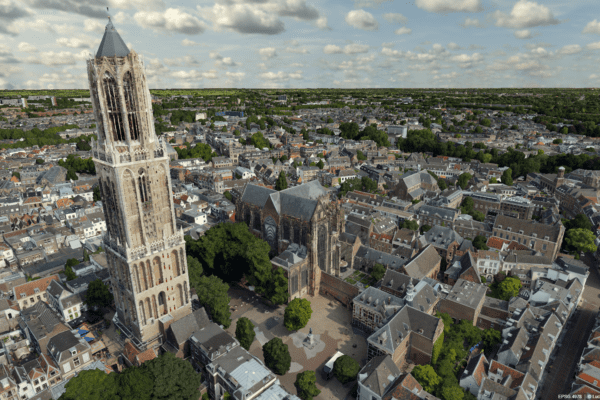
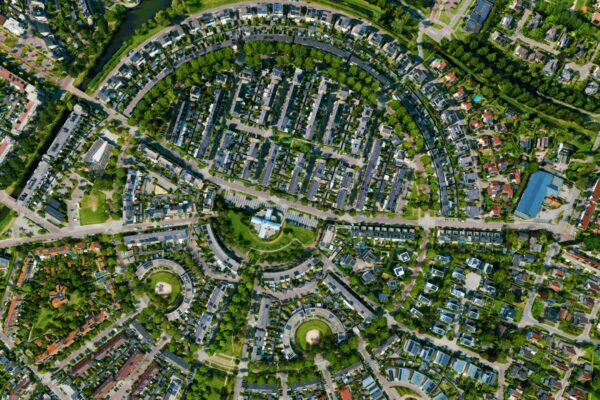
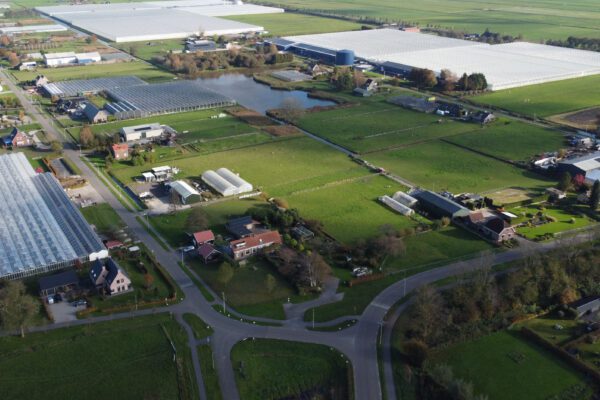
I’ve seen quite a few of them by now. “ Digital Twins ” in all sorts of forms, which, in fact, strive with all their might to be identical to the part of our real world that they reflect. It’s remarkable how technology enables us to digitally reproduce the physical world with millimeter-level precision. Sometimes in 2D, sometimes in 3D. Sometimes from above, sometimes from below. Including buildings, roads, trees, and even the shadows at a specific moment. You can hardly get enough of it.
What strikes me about all these Digital Twins sites is that they’re impressively detailed, yet at the same time strikingly quiet and empty. You hardly ever see residents, business owners, or officials walking around. It’s as if there were a permanent curfew in the digital world.
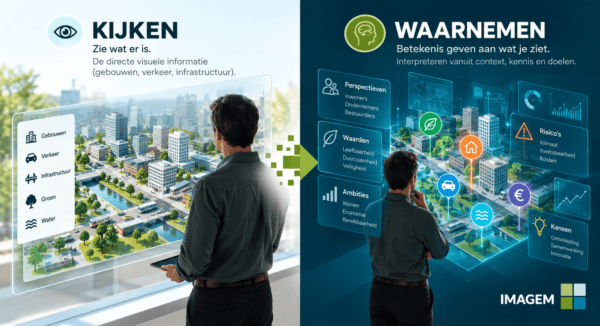
Sometimes you come across a lone, anonymous pedestrian or cyclist. Often a man walking or cycling through the empty city to show us that world from his perspective. Perfect. You look through his eyes at buildings, roads, and trees—at the new apartment building on the corner and the withered flowers in the planters in the park. But there’s a world of difference between seeing and observing.
From Seeing to Perceiving
Perception goes beyond simply registering what you see. It’s about the meaning you ascribe to that environment. How does that cyclist experience his neighborhood? Does he feel comfortable there? Is there enough greenery? Does he see his children growing up here? How does he experience the commute to the station?
Maybe he’s a business owner and is wondering whether his store will remain accessible to customers. Maybe he’s on the village council and sees an opportunity to work with other residents to preserve the village’s identity.
From a scientific perspective: between seeing and perceiving lies the cognitive process of assigning meaning. You understand and evaluate a situation based on your personal interests, values, and ambitions. You weigh recent developments against personal fears (managing risks), but also against the urge toward opportunism (seizing opportunities as they arise). It is precisely this layer that is missing in a traditional Digital Twin.
From " Digital Twin " to "Digital Reality"
Once you gain insight into how residents, business owners, and policymakers make sense of what they see, a whole new world literally opens up to you. That’s when a “ Digital Twin ” becomes a “Digital Reality.” Not a digital diorama where you only see what the physical world looks like, but a simulated reality in which you also perceive how people experience and value that world. That’s the essential difference. A “ Digital Twin ” provides insight into what exists. A “Digital Reality” adds insight into what that reality means to people. And it is precisely that insight that helps you take the lead and steer toward your goals.
Connecting Geo-Intelligence and Cognitive Science
At IMAGEM, experts in geo-intelligence and cognitive science work together to enrich traditional “ Digital Twins ” into “Digital Realities.” The digital replica of the physical world remains important in this process. You must first take a close look at reality before you can understand how people experience that reality.
We add a second layer to that. Through our approach and supporting technology, we also bring the cognitive world into focus: the interests, values, ambitions, and perspectives through which residents, entrepreneurs, and policymakers give meaning to their living environment. In this way, we connect physical reality with human reality.
Digital Reality for Complex Social Challenges
We apply this combination, among other things, to large-scale residential development projects, as well as to issues related to well-being, the economy, safety, and resilience.
I still find the difference between seeing and perceiving to be impressive. Because as soon as different perspectives become visible, there is room for understanding. You don’t just see what’s happening in an area, but also what changes mean for the people who live, work, do business, and make decisions there. That provides a richer foundation for weighing interests, making choices, and working together toward societal goals. In our digital world, there is more to discover than what meets the eye. By populating the “ Digital Twin ,” we can also learn to perceive that world and turn it into a “Digital Reality.”
More information
Wim is a Decision Architect at IMAGEM and specializes in artificial intelligence, knowledge technology, and smart decision-making. He focuses on complex issues where different interests, perspectives, and ambitions converge. In doing so, he helps organizations leverage knowledge and context in a way that makes their decisions not only smarter, but also well-founded and explainable.
At Digital Reality, Wim combines his expertise in cognitive science and decision-making with geo-intelligence and Digital Twin technology. This provides not only insight into the physical living environment but also into the ways in which residents, business owners, and policymakers perceive, value, and interpret that environment. This combination gives organizations a richer foundation for weighing interests, exploring scenarios, and steering their efforts toward societal goals.
Would you like to learn more about Digital Reality and what this approach means for your specific situation? Send Wim an email or contact us through ourcontact form.

Wim van Stokkum
Decision Architect