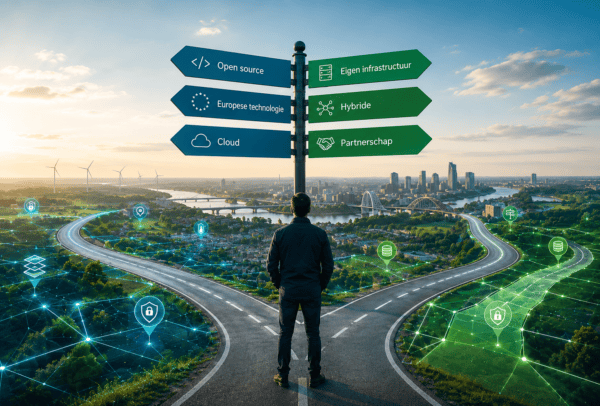

Digital dependence has long since ceased to be purely an IT issue. For governments, it directly affects autonomy, security, and administrative responsibility. Where is sensitive data stored, and who has access to it? How dependent are essential processes on foreign software and infrastructure? And what room remains to make different choices if legislation, geopolitical relations, or a supplier’s policies change?
For me, digital sovereignty is therefore all about freedom of choice. Not all technology has to come from Europe, as long as your organization makes informed choices, spreads risks, and avoids becoming completely dependent on a single supplier, ecosystem, or foreign jurisdiction. That starts with understanding your dependencies and identifying potential alternatives. How much flexibility do you have to change course if circumstances require it?
Digital dependence poses a governance risk
I’m reading more and more about the dependence of the Netherlands and Europe—not only on foreign raw materials, energy, and supply chains, but also on software, cloud platforms, and entire digital infrastructures. U.S. sanctions demonstrate that geopolitical decisions can affect access to digital services. Dutch studies also show that U.S. technology companies provide a large portion of the central government’s key cloud services.
If you work for the government, you handle sensitive personal data, geographic information, security data, and data related to critical infrastructure. When essential processes rely entirely on a limited number of foreign technology companies, this creates not only a technical risk but also an administrative and geopolitical risk.
The most important question, therefore, is not just: Does the technology work well? Equally important is the question: Who ultimately has control over the software, data, and services?
European Alternatives Strengthen Digital Autonomy
The Dutch government has revised its cloud policy and is placing greater emphasis on geopolitical risks and dependence on suppliers outside the EU. Other European countries are also actively seeking ways to strengthen their digital autonomy. Germany is replacing Microsoft solutions with open European alternatives in certain parts of the government. Denmark is experimenting with software it has developed in-house, and France has opted for its own video conferencing platform for the government.
These developments show that alternatives exist. Digital sovereignty, therefore, does not require replacing all technology from outside Europe. It is about making informed choices, spreading risk, and avoiding complete dependence on a single supplier, ecosystem, or foreign jurisdiction. That way, you remain in control.
Prevent vendor lock-in with a viable exit strategy
Don’t wait to discuss digital dependencies until a supplier goes out of business, legislation changes, or international tensions escalate. At that point, switching providers often takes a lot of time and money, becomes more complex, or there may not even be a realistic alternative. That’s precisely why it pays to identify your critical dependencies in advance. Which systems are essential? Where is the data stored? Which suppliers and jurisdictions are involved? What alternatives are available? And what would a realistic migration look like?
A credible alternative and a feasible exit strategy give you more freedom of choice. They contribute to continuity and ensure that decisions regarding data, technology, and infrastructure remain in your hands.
Digital sovereignty requires more than just technology
Digital sovereignty does not mean building everything yourself or replacing all technology from outside Europe. It is about consciously choosing which dependencies are acceptable, which risks you want to mitigate, and where an alternative is needed.
That is also where IMAGEM comes in. We serve as a technology and knowledge partner in complex social and spatial issues involving GIS, Remote Sensing and Digital Twins play an important role. In doing so, we look beyond the technology itself. We bring together domain expertise, architecture, and geospatial technology around themes such as data security, interoperability, open standards, European software alternatives, and the prevention of vendor lock-in. The origin of the technology also plays a role in this. For example, we work with geospatial technology from the Irish company Octave Intelligence plc, a subsidiary of the Swedish company Hexagon AB. This technology supports the management, analysis, integration, and visualization of geographic and operational information.
Which choices are right for your situation depends on your existing environment, dependencies, and ambitions. That’s why, for us, digital sovereignty doesn’t start with replacing technology, but with understanding dependencies, exploring alternatives, and having the freedom to change course when necessary. Digital sovereignty doesn’t mean building everything yourself. It means remaining in control of your own decisions.
About IMAGEM
For organizations where autonomy, data security, and business continuity are essential, we are happy to collaborate on:
- secure digital ecosystems
- European software alternatives
- sovereign infrastructures
- Open systems/platforms (standards and interoperability)
- reducing vendor lock-in
- architectures in which organizations retain control
More information
Niels is the Government Market Manager at IMAGEM. He helps government agencies continuously work smarter and more effectively, and fulfills his role by supporting organizations in solving their challenges. Want to learn more? Send Niels an email or send a message via our contact form.

Niels van de Graaf
Government Market Manager