
An overview as the basis for faster, better-informed, and future-proof decision-making
The government’s societal challenges are becoming increasingly intertwined. Issues surrounding, for example, housing construction simultaneously touch on aspects related to mobility, energy, water, climate, and public space. As a result, rapid, well-founded, and future-proof decision-making is becoming increasingly complex. This complexity calls for a clear overview—of interests, objectives, policies, and ambitions within each domain and organization. It also requires an understanding of relevant regulations and case law in the context of the task at hand and the impact of decisions. Digital transformation plays a crucial role in making this possible. That is why this theme is central to Part 2 of this three-part series.
Complexity is making decision-making increasingly challenging
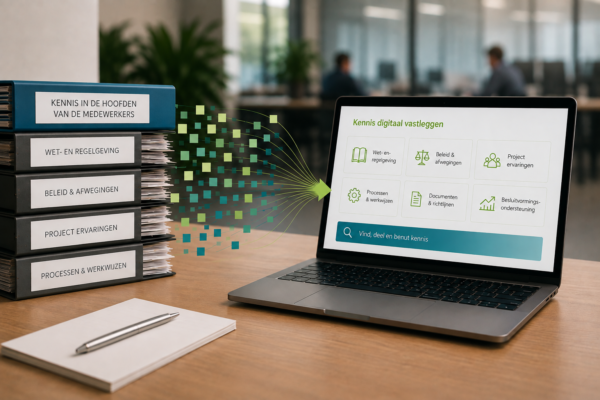
The first article in this three-part series focused on knowledge retention. Experienced employees are leaving or will be leaving in the coming years, while a large portion of their (tacit) knowledge has not been formally documented. By digitally capturing that knowledge in a structured manner and making it immediately available at the moment of decision-making, valuable expertise remains an integral part of decision-making and day-to-day work. However, when it comes to creating clarity amid complexity in decision-making, the process of capturing and applying tacit knowledge is only the beginning.
An increasing number of societal challenges are closely intertwined. This requires an understanding of the interrelationships between objectives, the interests of the various sectors involved, and the impact of decisions on these sectors. In practice, however, this integrated perspective is often lacking in the decision-making process. Furthermore, there is frequently insufficient clarity regarding the interrelationships between the ambitions, objectives, regulatory frameworks, and interests of the organization as a whole. As a result, these aspects are not sufficiently taken into account when making decisions.
On top of that, changes are coming at us faster and faster. New regulations, shifting financial constraints, technological developments, and societal priorities all influence the context in which you make decisions. A decision that makes sense today may need to be adjusted tomorrow. As a result, it’s not just the volume of information that’s growing; the number of relationships between information, interests, and choices is also increasing. Knowing and understanding those relationships determines the quality of decision-making and, therefore, the need for the right overview.
Taken together, these factors make rapid, well-informed, and future-proof decision-making regarding these challenges complex and difficult. When a clear overview is needed, the current decision-making process does not make the situation any easier.
Why Traditional Decision-Making Hinders a Comprehensive Overview and Slows Down Decision-Making
Many organizations make decisions based on separate domains, departments, and systems. In practice, each discipline often approaches matters from the perspective of its own specific task, uses its own information, and draws on other areas of expertise at different stages of the process. As a result, decision-making in practice often proceeds sequentially: first, one domain reviews and evaluates a plan or project from its own perspective, develops it further, and makes recommendations. The plan then moves on to the next department or domain, where the same process is repeated. This not only slows down the decision-making process but also results in a lack of integrated coordination and collaboration. Consequently, this approach hinders a comprehensive overview. However, because the tasks are so closely intertwined, this creates risks. Dependencies are identified late in the process, conflicts of interest only arise later on, and new information leads to additional coordination or even a reevaluation of plans. Therefore, to prevent the loss of valuable time and money, a comprehensive overview and coherence are essential. But how can this be achieved?
Digital transformation is an opportunity for Digital Twins technology
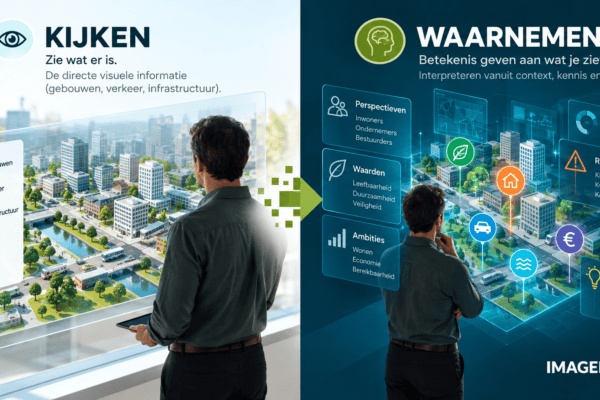
This is where digital transformation takes on concrete meaning. Digital Twin technology is uniquely suited to providing clarity amid complexity and supporting sound, rapid, and future-proof decision-making. It is capable of bringing together and visualizing data, knowledge, policy frameworks, objectives, ambitions, interests, and regulatory frameworks within a single, cohesive digital environment. These various sources and perspectives can be dynamically applied, evaluated, and visualized in relation to a specific task. And that (dynamic) visualization is particularly important. It creates a single shared information base in which everyone understands the situation, the concepts, relationships, and context. This is essential for taking a cross-domain view of the same challenge, discussing it collectively, and explicitly weighing interests against one another.
You can have that discussion at the “project or task level”—for example, using a dynamic “discussion board”—but also at the “overarching project level,” such as through a steering committee. Maps, 3D environments, scenarios, models, dashboards, and interactive widgets show where interests intersect, where bottlenecks arise, and what the impact of different choices will be. This approach provides clarity and understanding, allowing you to discuss “the best choice” at that moment.
With the support of “ digital twin ” technology, this approach also immediately transforms the way you collaborate and your decision-making process. Instead of having disciplines review issues sequentially one after another, you bring relevant areas of expertise together earlier and in parallel. Housing, mobility, energy, finance, and other relevant sectors address the same challenge simultaneously, based on the same information and within the same context. Dependencies are addressed sooner, and alternatives are discussed immediately from multiple perspectives. In this way, technology in the form of a “ digital twin ” provides experts with a common foundation for reaching well-informed decisions more quickly.
Digital Reality Aligns Execution with Strategic Policy
Digital Twin Technology is therefore ideally suited to providing clarity on the interrelationships and dependencies within tasks or projects. However, to ensure that decision-making is future-proof, it is necessary to understand how the choices made within a task relate to your organization’s strategic objectives, interests, and ambitions. And which laws and regulations play a role in this. It is precisely this connection between strategic policy and implementation that is often missing, and it also ensures that working with “ Digital Twins ” often gets stuck at the level of individual projects and does not become an integral part of decision-making throughout the entire organization.
This is where IMAGEM’s added value lies. With expertise in knowledge automation, IMAGEM works with the organization to map out its (overarching) policy objectives, interests, relevant laws and regulations, and the relationships between them. By integrating this knowledge into a “ Digital Twin ” of the physical environment, a single digital collaboration environment is created where you can immediately incorporate the relevant policy frameworks and interests into the proper context when evaluating plans and scenarios. We call this approach Digital Reality.
Digital Reality thus serves as a connecting link between strategy and execution. You can see how projects contribute to organizational objectives or where decisions conflict with broader ambitions. By incorporating the organization’s interests and goals into individual tasks and projects, they become the building blocks for lasting change and a new way of working within the organization—one that is future-proof, flexible, and agile in times of change.
Comprehensive insight enhances quality, speed, and agility
When you have a clear overview of a task and understand the situation and dependencies, the quality of the discussion changes. You’re better able to identify where interests conflict, understand dependencies more clearly, and compare alternatives from multiple perspectives. As a result, the rationale behind decisions becomes data-driven, traceable, and more transparent.
With a holistic view, the decision-making process also becomes faster and more efficient because everyone looks at and discusses the task together at the same time. Less time is wasted on gathering, comparing, and reinterpreting information. Scarce financial resources are allocated in a more targeted manner and are aligned with objectives. Costs resulting from late-discovered dependencies or missing information are minimized.
The agility component is just as important. If a premise, rule, project, or data source changes, you can see what that means for the overall coherence and the trade-offs involved. This creates an organization that responds more quickly to change without having to start from scratch every time a new development arises.
Comprehensive insight does not make complex challenges easy, but it does make their complexity manageable. And it is precisely this that supports faster, better-informed, and future-proof decision-making and, with an eye toward the future, provides a concrete way to work smarter with fewer available resources.
Digital transformation begins with an initial, concrete societal challenge
True digital transformation does not happen by completely restructuring the entire organization all at once. In practice, successful digital transformation is achieved through controlled, step-by-step change. Start with a specific task and identify the knowledge, information, rules, interests, and dependencies required. Connect the relevant elements surrounding the task at hand to create a clear overview, and organize the discussion in an integrated manner from the very beginning. This changes more than just the flow of information; it changes the way people collaborate, weigh options, and make decisions.
Technology lays a solid foundation and helps drive that change by making connections accessible and understandable and by facilitating dialogue. But only when employees accept the new way of working and apply it systematically does digital transformation evolve into a structurally improved and lasting capacity for execution. How to organize that change, get people on board, and start small while making a structural impact is the focus of the third and final part of this three-part series.
Three-Part Series: Digital Transformation in Government
Reduced capacity and increasingly complex societal challenges call for a different way of working. Digital transformation helps strengthen operational capacity, agility, and the quality of service delivery. Three elements are central to this:
- Preserving and Leveraging Knowledge: Capturing valuable expertise and making it immediately available for work and decision-making, even if it currently resides primarily in employees’ minds.
- Creating a Comprehensive Understanding: Linking information and data to reveal connections and interdependencies within complex societal challenges, thereby supporting faster and future-proof decision-making.
- Organizing Change: Integrating New Work Methods and Technology into Daily Practice.
More information
Stefan is a Business Consultant at IMAGEM, working in the public sector with a focus on water authorities and municipalities. His expertise lies in clarifying complex production, operational, and decision-making processes, with the goal of accelerating and improving the evaluation of options and decision-making in a data-driven, transparent, and integrated manner.
He helps government organizations tackle complex social issues and implement more efficient and effective working methods, focused on the challenges of today and tomorrow. Modern digital twin and knowledge technology play an important role in this.
Want to know more? Send Stefan an email or send a message through our contact form.

Stefan Lijst
Business Consultant