
How to Retain Valuable Knowledge and Apply It Immediately for Faster, More Informed Decision-Making
An aging population, loss of knowledge, and increasingly complex societal challenges are putting pressure on the government’s ability to deliver services. A digital transformation is necessary to retain valuable expertise, document knowledge, make decisions more quickly, and ensure your organization is ready to act effectively in the future.
This first part of the three-part series focuses on knowledge preservation. What does the loss of experience and expertise mean for the government? Why are traditional methods insufficient in addressing this issue? And how does digitization help capture valuable knowledge, make it available, and apply it directly in work and decision-making?
Digital transformation is no longer a choice
The government is facing a fundamental shift. While societal challenges are becoming increasingly complex, the regulatory burden is growing, and changes are occurring at a rapid pace, the capacity to implement policies is declining. Issues such as climate change, the energy transition, and housing construction require swift decision-making. They also require a comprehensive overview when balancing competing interests and insight into the consequences of policy choices. As a result, the pressure on implementation is increasing. At the same time, however, experienced colleagues are leaving, valuable knowledge is being lost from organizations, and the labor market is becoming increasingly tight. Consequently, the capacity to implement policies is declining.
The reality is clear. In the coming years, you’ll have to accomplish more with fewer people, while the world is changing faster and complexity is only increasing. Simply working harder won’t solve this. Neither will digitization or a mere “tech push.” What will work is a fundamentally different approach to work and business operations: digital transformation. It is a necessary step for any government organization that wants to maintain its operational capacity, agility, and quality of service delivery.
Digital Transformation and the 3 Key Elements for the Government
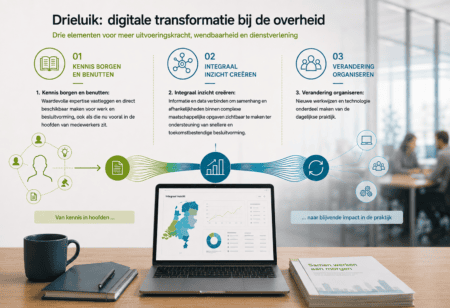
Digital transformation, therefore, is about a different way of thinking, organizing, and collaborating. When it comes to the challenges the government will face in the future, three elements play a key role:
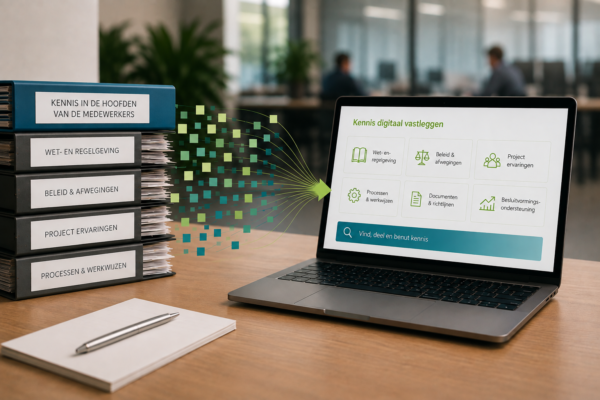
- documenting knowledge and making it immediately available to support decision-making—including the knowledge that currently resides primarily in employees’ minds.
- a comprehensive understanding of complex societal challenges and their interdependencies
- the organization's ability to adapt to change
These three elements reinforce one another. Precisely at a time when an aging workforce is leading to a loss of knowledge, the importance of knowledge is increasing due to growing complexity. At the same time, the potential of available technology often remains untapped due to limited adoption and insufficient structural integration into daily work processes. As a result, knowledge remains fragmented and is not sufficiently integrated into daily work and comprehensive decision-making.
An aging workforce and the loss of knowledge make knowledge retention crucial
As noted earlier, the government will lose a large portion of its experienced staff in the coming years. It is expected that within ten years, approximately one-third of the current workforce will leave due to retirement. This will result in the loss not only of capacity, but also of valuable knowledge regarding processes, legislation, administrative considerations, and decision-making.
It is precisely that knowledge that determines the quality of our work every day. Much of that knowledge is tacit. It resides in experience and in the minds of employees. In self-developed tools and informal work practices. And it is precisely this crucial form of knowledge that is often insufficiently documented—or not documented at all. If that knowledge is not preserved in a timely manner, dependence on fragmented information, scattered documents, and manual knowledge transfer increases. This increases the workload, slows down processes, and makes the quality and execution of public tasks more vulnerable.
By systematically documenting knowledge and making it an integral part of work and decision-making processes, valuable expertise is preserved and remains available to the entire organization. Safeguarding, automating, and making implicit knowledge actionable is therefore a prerequisite for a future-proof and agile government. It is a crucial component of this digital transformation process.
Effective knowledge management speeds up decision-making
But simply documenting knowledge isn’t enough. The real added value only emerges when you can actively apply that knowledge in your day-to-day work and decision-making. Only then does knowledge remain a lasting asset within the organization, rather than information getting lost in documents or remaining dependent on individual employees.
This requires a specific approach to knowledge management. It involves not only documenting policy frameworks, implementation knowledge, and decision-making criteria, but above all structuring both explicit and implicit knowledge in such a way that it becomes immediately available when decisions are made. In this way, knowledge becomes an integral part of work and decision-making processes. And by linking knowledge to (location) data and processes, an integrated and up-to-date foundation for decision-making is created. Employees operate from the same information base, use the same principles, and make complex assessments more quickly and consistently. This increases the speed, quality, and transparency of decisions. At the same time, dependence on individual expertise decreases, and the organization’s agility increases.
Provided it is well-structured and immediately available during the decision-making process, knowledge management lays the foundation for the desired digital support that helps employees make decisions more quickly, with a stronger basis, and with greater confidence.
Approach digital transformation from the perspective of the challenge, not from the perspective of technology
The challenges posed by an aging population and knowledge loss are nothing new. Governments have been investing heavily in digitization, data, and new systems for years. Yet in practice, the impact often remains limited. Many organizations have data, dashboards, and applications, but lack coherence, an overall view, and structural adoption in their day-to-day operations. This is because digital transformation is still too often approached as a technological issue. The focus is on systems and tools that improve existing processes or make them more efficient—and thus on digitization rather than transformation. Because the way of thinking and working remains the same, results often get stuck at the level of isolated initiatives, pilot projects, and technical discussions.
The real challenge lies elsewhere. Digital transformation is all about organizing collaboration, knowledge sharing, and decision-making. That starts with redesigning processes, not with implementing new technology. That change therefore doesn’t start with systems, but with the task at hand. Which social issues require accelerated action? Which decision-making processes take up an unnecessary amount of time, and why? What knowledge is at risk of being lost, and what do I need to safeguard as quickly as possible? What information is missing to enable integrated management? When these questions take center stage, technology assumes the role for which it is intended in a digital transformation process: adding value by supporting employees and strengthening execution.
Start small. But start.
Many organizations are looking for a major digital breakthrough or to have their data 100% in order. In practice, however, successful digital transformation comes about precisely through controlled, step-by-step change. That makes sense. After all, digital transformation affects not only systems but also work processes, responsibilities, and collaboration between teams. Change therefore requires buy-in, trust, and room to learn. So start small—don’t begin with a large-scale program. Choose a specific task from your daily work and ask the same questions as above. Where does implementation get stuck, and why? Which decision-making processes take up an unnecessary amount of time, and why? Where is crucial knowledge at risk of being lost, and what do I need to document?
By working within the framework of a clearly defined task, we create the space to improve processes step by step, strengthen collaboration, and introduce new work methods and technology in a controlled manner. Small successes build confidence, accelerate acceptance, and make the next step easier. In this way, digital transformation gradually but surely evolves into a structural improvement in operational effectiveness, rather than a temporary innovation project. So start small and manageable. Start with the task at hand. But above all, just get started.
An Approach to True Digital Transformation
As mentioned, digital transformation requires more than just new technology. It requires a comprehensive approach in which knowledge, (work) processes, (location) data, and decision-making reinforce one another. In addition, employees’ willingness to think and work differently plays a key role in the success of this transformation. Based on this conviction, IMAGEM supports government organizations in tackling complex societal challenges—not by focusing on technology, but by starting with the challenge itself and the way people collaborate, make decisions, and share knowledge.
By combining domain expertise, process design, and digital technology, we create an approach that helps organizations operate in a structurally smarter and future-proof manner. Knowledge is retained. Decision-making becomes faster and better-informed. Acceptance and adoption are increased. And implementation becomes more coherent and manageable. At IMAGEM, we call this approach Digital Reality.
Digital Reality provides concrete solutions for the three elements that play a key role in the challenges governments will face in the future. It thereby offers the opportunity to achieve a true digital transformation and, in doing so, to maintain—and even improve—the effectiveness, continuity, and quality of service provided by organizations and knowledge workers.
From Documented Knowledge to Clarity Amid Complexity
As we have read, knowledge retention is a key element in helping the government prepare for the challenges of an aging population and the knowledge drain of the near future. However, practice shows that knowledge retention alone is not enough to make the government “future-proof” in its digital transformation process. The increasing complexity of societal challenges also has a major impact on the ability to make rapid and well-informed decisions and policy considerations. That complexity places new demands on the way we collaborate, share information, and make decisions. In addition to maintaining an overview within a given challenge, cross-domain insight and collaboration are therefore essential. How to implement this within the context of digital transformation is the focus of the second part of this three-part series.
Three-Part Series: Digital Transformation in Government
Reduced capacity and increasingly complex societal challenges call for a different way of working. Digital transformation helps strengthen operational capacity, agility, and the quality of service delivery. Three elements are central to this:
- Preserving and Leveraging Knowledge: Capturing valuable expertise and making it immediately available for work and decision-making, even if it currently resides primarily in employees’ minds.
- Creating a Comprehensive Understanding: Linking information and data to reveal connections and interdependencies within complex societal challenges, thereby supporting faster and future-proof decision-making.
- Organizing Change: Integrating New Work Methods and Technology into Daily Practice.
In this three-part series, we’ll take a closer look at all three elements and their role in digital transformation within the government. This first part focuses on securing and leveraging knowledge.
More information
Stefan is a Business Consultant at IMAGEM, working in the public sector with a focus on water authorities and municipalities. His expertise lies in clarifying complex production, operational, and decision-making processes, with the goal of accelerating and improving the evaluation of options and decision-making in a data-driven, transparent, and integrated manner.
He helps government organizations tackle complex social issues and implement more efficient and effective working methods, focused on the challenges of today and tomorrow. Modern digital twin and knowledge technology play an important role in this.
Want to know more? Send Stefan an email or send a message through our contact form.

Stefan Lijst
Business Consultant